 PhD Student at Rice University
I specialize in human-centered artificial intelligence, focusing on AI transparency and improving human-robot collaboration. Currently, I’m a researcher in the Teaming Lab at Rice University, where I explore how AI can help people better understand and work alongside intelligent systems. I aim to design AI that both supports people in their tasks and makes working with technology more intuitive and effective.
Warning
Problem: The current name of your GitHub Pages repository ("Solution: Please consider renaming the repository to "
http://".
However, if the current repository name is intended, you can ignore this message by removing "{% include widgets/debug_repo_name.html %}" in index.html.
Action required
Problem: The current root path of this site is "baseurl ("_config.yml.
Solution: Please set the
baseurl in _config.yml to "Education
-
Rice UniversityDepartment of Computer Science
Ph.D. in Computer ScienceAug 2025 - Present -
Rice UniversityDepartment of Computer Science
M.S. in Computer ScienceJan 2024 - May 2025 -
Rice UniversityDepartment of Computer Science
B.S. in Computer Science
Minor in MathematicsAug 2020 - Dec 2023
Experience
-
Rice UniversityHuman-Centered AI and Robotics Lab ResearcherApr 2022 - Present
-
Rice UniversityLead Event Planner, CS Graduate Student AssociationAug 2023 - Present
-
Delta Air LinesArtificial Intelligence Engineer InternJun 2024 - Aug 2024
-
Rice UniversityComputer Science Teaching AssistantAug 2021 - Present
-
Rice UniversityJones College WebmasterMar 2022 - Dec 2023

Honors & Awards
-
IES Students and Young Professionals Paper Assistance Program (IES-SYPA)Aug 2026
-
2025 NSF GRFP Honorable MentionApr 2025
-
2nd Place, IEEE Computer Society North America Student Challenge CompetitionDec 2024
-
AIES 2024 Student Travel AwardOct 2024
-
Rice Engineering Alumni (REA) Graduate Student Travel GrantOct 2024
-
Rice University MS Fellowship AwardJan 2024
-
President's Honor RollDec 2023
-
Segal AmeriCorps Education AwardAug 2021
News
Selected Publications (view all )
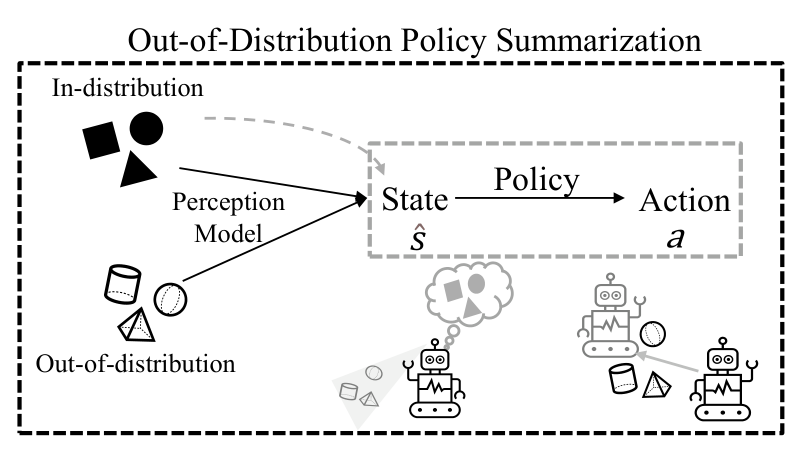
OOPS: Out-of-Distribution Policy Summarization
Harrison Huang, Yao Rong, Peizhu Qian, Vaibhav Unhelkar
IEEE/RSJ International Conference on Intelligent Robots and Systems (IROS) 2026
Robots are increasingly deployed across diverse real-world domains. As they assume critical roles, it becomes essential for humans to understand how they sense, reason, and act to ensure safe and responsible use. Recent advances in Explainable AI (XAI) have sought to support this understanding through the explanation-by-example paradigm. Specifically, policy summarization has emerged as a promising solution, generating summaries composed of representative examples of robot behavior for users. However, existing methods select examples only from the robot's training set (i.e., in-distribution scenarios). As such, they fail to capture a variety of scenarios that the robot would encounter in practice but are absent from its training set (i.e., out-of-distribution scenarios). We argue that holistic explanations, containing both in-distribution and out-of-distribution examples, are crucial for fostering human understanding of robot behavior. To address this gap, we introduce Out-of-Distribution Policy Summarization (OOPS), an explanation-by-example approach designed to jointly teach users how robots perceive, reason, and act in novel scenarios.
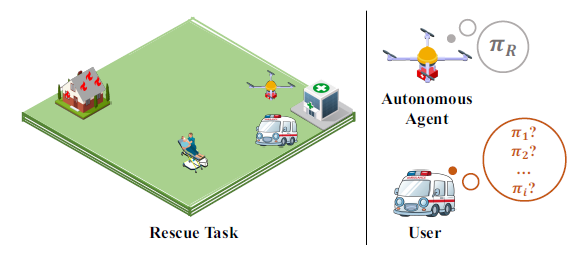
PPS: Personalized Policy Summarization for Explaining Sequential Behavior of Autonomous Agents
Harrison Huang*, Peizhu Qian*, Vaibhav Unhelkar (* equal contribution)
AAAI/ACM Conference on AI, Ethics, and Society (AIES) 2024 Spotlight
Policy summarization methods aim to showcase key examples of agent behaviors to their human users. Yet, existing methods produce “one-size-fits-all” summaries for a generic audience ahead of time. Drawing inspiration from research in pedagogy, we posit that personalized policy summaries can more effectively enhance user understanding. To evaluate this hypothesis, this paper presents and benchmarks a novel technique: Personalized Policy Summarization (PPS). PPS discerns a user’s mental model of the agent through a series of algorithmically generated questions and crafts customized policy summaries to enhance user understanding. Unlike existing methods, PPS actively engages with users to gauge their comprehension of the agent behavior, subsequently generating tailored explanations on the fly. Through a combination of numerical and human subject experiments, we confirm the utility of this personalized approach to explainable AI.