Publications
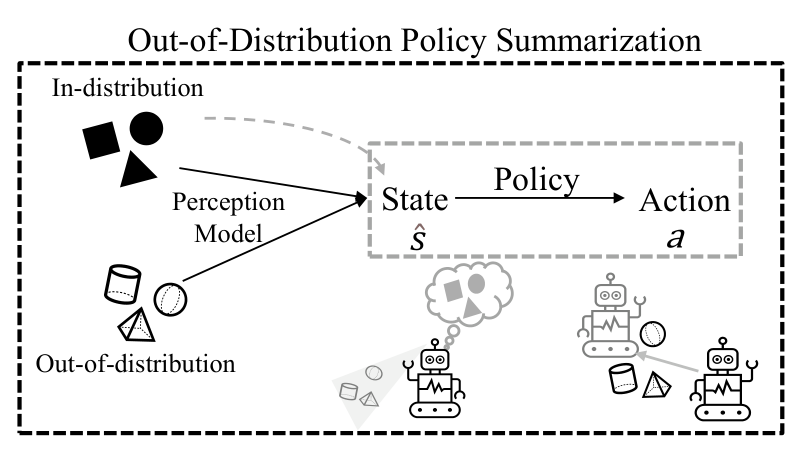
OOPS: Out-of-Distribution Policy Summarization
Explainable AI Robotics
IEEE/RSJ International Conference on Intelligent Robots and Systems (IROS) 2026
Robots are increasingly deployed across diverse real-world domains. As they assume critical roles, it becomes essential for humans to understand how they sense, reason, and act to ensure safe and responsible use. Recent advances in Explainable AI (XAI) have sought to support this understanding through the explanation-by-example paradigm. Specifically, policy summarization has emerged as a promising solution, generating summaries composed of representative examples of robot behavior for users. However, existing methods select examples only from the robot's training set (i.e., in-distribution scenarios). As such, they fail to capture a variety of scenarios that the robot would encounter in practice but are absent from its training set (i.e., out-of-distribution scenarios). We argue that holistic explanations, containing both in-distribution and out-of-distribution examples, are crucial for fostering human understanding of robot behavior. To address this gap, we introduce Out-of-Distribution Policy Summarization (OOPS), an explanation-by-example approach designed to jointly teach users how robots perceive, reason, and act in novel scenarios.
Personalized Explanations of Robot Behavior for Human Users
Explainable AI Robotics
M.S. Thesis, Rice University, 2025
AI and robotic agents are becoming increasingly prevalent in sectors such as transportation, manufacturing, and disaster response. As these robots are integrated into existing workflows, it is important for their users to understand and anticipate their actions to ensure efficient human-robot collaboration. Most notably, explainable AI (XAI) has emerged as a solution for making robot behavior more transparent. However, a major challenge remains: each user has their own preconceptions of the robot, meaning that a single explanation method may not be effective for everyone. This thesis explores the role of personalized explanations in improving human users' ability to understand robot behavior. We design an algorithm, PPS, to model a user's knowledge about a robot to select informative explanations tailored to that user. We also introduce STOREE as a paradigm for users to personalize their lesson modality. Through our experiments, we find evidence that personalization increases user knowledge of robot behavior.
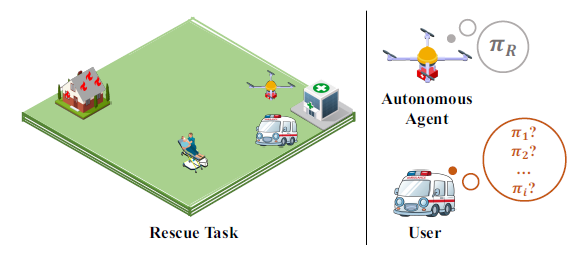
PPS: Personalized Policy Summarization
Explainable AI Human-Robot Interaction
AAAI/ACM Conference on AI, Ethics, and Society (AIES) 2024 · Spotlight
Policy summarization methods aim to showcase key examples of agent behaviors to their human users. Yet, existing methods produce “one-size-fits-all” summaries for a generic audience ahead of time. Drawing inspiration from research in pedagogy, we posit that personalized policy summaries can more effectively enhance user understanding. To evaluate this hypothesis, this paper presents and benchmarks a novel technique: Personalized Policy Summarization (PPS). PPS discerns a user’s mental model of the agent through a series of algorithmically generated questions and crafts customized policy summaries to enhance user understanding. Unlike existing methods, PPS actively engages with users to gauge their comprehension of the agent behavior, subsequently generating tailored explanations on the fly. Through a combination of numerical and human subject experiments, we confirm the utility of this personalized approach to explainable AI.